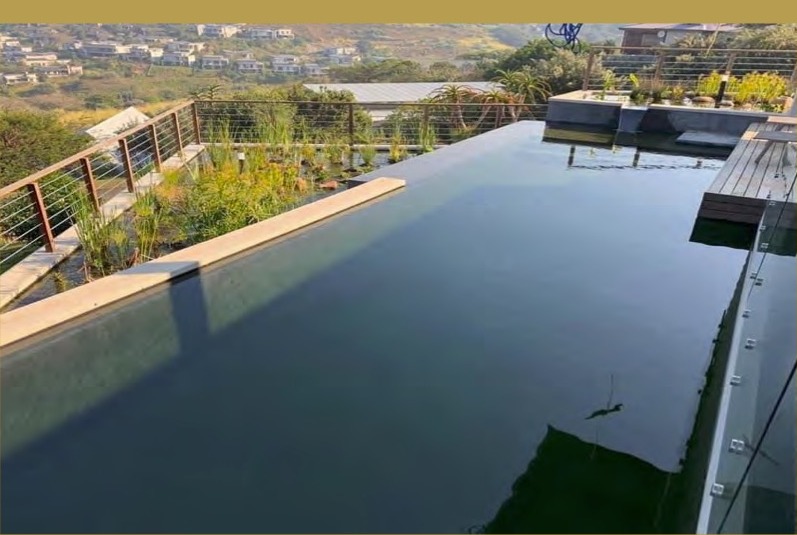
The routine
Skim the surface, and skim it properly — leaves that sink and rot are the nutrient load that feeds algae, and a skimmer catching them before they sink does more for clarity here than any chemical does on a conventional pool. Beyond that: manage the plants, keep the gravel bed clear of sediment, and brush biofilm where it builds. One South African specialist describes fortnightly backwashing of their engineered filter and roughly weekly biofilm brushing; a planted pond's cycle is seasonal rather than weekly.
What you are actually managing is phosphorus. Clarity in a natural pool is a nutrient-limitation problem: plants and filter media compete with algae for dissolved phosphate, and when the phosphate is low enough the algae have nothing to grow on. The published target is a total phosphorus of 0.03 mg/L — a very low number, and the reason soil, compost, fertiliser runoff, duck traffic and unskimmed leaf litter matter so much more here than they would in a chlorinated pool. Other published parameters for a bathing pond are oxygen 4–12 mg/L, pH 6.9–9.0, conductivity 200–1,000 µS/cm, nitrate 10–30 mg/L and nitrite essentially nil.
Two things to be clear-eyed about. There is no South African water-quality standard for a domestic natural pool — the figures above come from German and Czech practice via the European literature, and SANS 10134, South Africa's pool standard, addresses safety rather than water quality. And "chemical-free" is a claim to test, not a category. The engineered route uses a phosphate-binding filter, which is chemistry doing the work even though nothing is dosed; at least one South African specialist reserves the right to raise mineral ioniser levels temporarily if algae appears, which is a metal-ion sanitiser by another name. The international bodies that define this type say water is treated by biological and mechanical means only, and one trade definition explicitly excludes devices that disinfect or sterilise — which would rule out UV and ozone. The peer-reviewed literature is blunter, noting UV destroys as much as 90% of microbes including the useful ones the system depends on. If a builder proposes UV, ozone or ionisers, ask them to explain how that squares with the pool being natural. It is a fair question and a good builder will have a straight answer.
Power, and the number to demand in writing
This is the type's running-cost story the way heating was the lap pool's. A conventional pool runs its pump about eight hours a day. A natural pool circulates continuously through the swimming season — the only South African specification we found says a low-power pump running 24/7, with reduced or no running through winter as the biology goes dormant.
Whether that is cheap depends on the pump, and no South African natural-pool supplier publishes a kW rating. The only figure available anywhere is an international manufacturer's description of consumption "equivalent to two 100-watt light bulbs" — around 0.2 kW — which is physically plausible, because these filters are not pressurised vessels and so need far less head than a conventional sand filter.
Here is the arithmetic, at R4.00/kWh, the 2026 working rate (kW × hours × 30 days × R4.00). These are calculations, not quoted prices:
- At 0.2 kW, 24 hours a day: R576 a month
- At 0.75 kW, 24 hours a day: R2,160 a month
- At 1.1 kW, 24 hours a day: R3,168 a month
- A conventional pool for comparison, 1.1 kW at 8 hours: R1,056 a month
So the low-wattage claim is the whole argument. If it holds, the pool beats a conventional one on electricity and saves the chemical spend. If an ordinary pool pump is installed and simply left running, the electricity bill alone is R1,100–R2,100 a month worse than a conventional pool, which swallows the chemical saving several times over. Make the pump's kW rating a written line in your quote.
Against the electricity, the credits are real: no chlorine (2 kg costs around R230–R250 and 8 kg around R460–R500 as of August 2026), no pool acid, no salt-chlorinator cell to replace at R5,000–R6,900 for a typical residential unit, and no acid wash at R1,500–R5,500. What South African sources publish nothing on is the other side of the ledger — plant replacement, gravel-bed cleaning and specialist natural-pool servicing. Assume they exist and ask what they cost.
Water — and the honest version of the no-backwash argument
The no-backwash claim is true and quantifiable. A conventional sand filter sends 200–900 litres down the drain per backwash, typically fortnightly and up to weekly in heavy summer use — call it 400–1,800 litres a month, more in a hard-used summer. There is no equivalent on a natural pool, and no annual drain-and-refill either.
But you built more open water, and open water evaporates. Working from South African evaporation figures of about 3 litres per square metre per day in summer conditions, a regeneration zone sized at 30–35% of total surface alongside a conventional 8 × 4 m swim area adds roughly 14–17 m² of surface, and therefore about 1,200–1,600 litres a month of extra evaporation in summer. That is the same order of magnitude as the backwash you are no longer doing. It may well be more, because a densely planted shallow bed also loses water through the plants themselves, and we could find no South African figure for that.
The honest position, which we have not seen any source state: a natural pool's water advantage over a conventional pool is real but much smaller than the "no backwash, no draining" framing implies, because the regeneration zone quietly gives a good part of it back. It is still a better water story than a conventional pool — just not a transformative one.
Then Cape Town, where two permanent rules — permanent, not tied to a restriction level — were plainly not written with this pool in mind.
The one that is unambiguous: automatic top-up systems using a float valve fed from a potable water source are not allowed, and the by-law names "swimming pools and garden ponds". Whichever of those two a natural pool is, it is caught. A pool with a large shallow evaporating surface needs regular topping up, and the labour-saving way of doing that is banned. What remains is manual top-up, or top-up from a non-potable source such as rainwater or a borehole — the prohibition is on the potable supply, not on topping up.
The one that collides: the same regulations require that "all swimming pools must be covered by a pool cover to avoid evaporation when not in use". You cannot cover a planted regeneration zone. And here the by-law does something interesting — it never defines "swimming pool" at all. The float-valve rule names pools and garden ponds as two separate things, which is some evidence the drafter distinguished them; the cover rule names only pools. So there is a real argument that a planted swimming pond is not caught, and an equally real argument that a thing sold and used as a swimming pool is one.
We could find nothing from the City, from any South African pool industry body, or from any natural-pool builder addressing this. The clearest demonstration of the silence: a Cape Town natural-pool builder's own site discusses pool covers twice — for heat retention and for reducing water loss — and never mentions that covers are legally required in the city it operates in. If you are building a natural pool in Cape Town, put the question to the City's Water and Sanitation Department in writing before you design. Covering only the swim zone is the obvious engineering answer, and nobody has confirmed it discharges the obligation — so treat it as the question to ask, not as the answer. Elsewhere, Johannesburg and eThekwini restrictions bear on filling and topping up as they do for any pool; check your own municipality's current status before you plan a fill.
Planting is a legal question in South Africa
This is the part of owning a natural pool that no competitor page mentions, and it is the one with actual legal consequences.
South Africa regulates alien and invasive species under the National Environmental Management: Biodiversity Act, and the aquatic plants most commonly sold for garden ponds are, almost without exception, listed. From the current national list:
| Plant | Category | |---|---| | Water hyacinth (Eichhornia crassipes) | 1b | | Parrot's feather (Myriophyllum aquaticum) | 1b | | Kariba weed (Salvinia molesta) | 1b | | Red water fern (Azolla filiculoides) | 1b | | Dense water weed (Egeria densa) | 1b | | Canadian water weed (Elodea canadensis) | 1b | | Water lettuce (Pistia stratiotes) | 1b | | Indian shot (Canna indica) | 1b | | Mexican water lily (Nymphaea mexicana) | 1b | | Yellow flag iris (Iris pseudacorus) | 1a | | Hydrilla verticillata | 1a | | Delta arrowhead (Sagittaria platyphylla) | 1a |
Every one of those is in the two most serious categories. There is no permitted middle ground among them. The sharpest illustration is within a single genus: the Mexican water lily is a listed invasive, while South Africa's indigenous blue waterlily (Nymphaea nouchali var. caerulea) is not listed at all. Same look, opposite legal standing.
What we deliberately are not telling you is exactly what the law obliges a landowner to do about each category, because we could not source it to a standard we would publish — South Africa's national invasive species information hub is currently offline behind a holding page, which is why this is harder to establish than it should be. The categories carry real duties, including on property sale. Get them from your builder, a botanist or the gazette, not from us.
The constructive half: indigenous species suitable for a regeneration zone do exist and are documented. SANBI's own plant database covers Cape pondweed (Aponogeton distachyos) and the blue waterlily; South African planted pools have used bulrush (Typha capensis), Cape blue water lily, restios (Calopsis paniculata, Restio festuciformis) and red hot poker (Kniphofia praecox). Note that this palette is overwhelmingly Cape and fynbos — which is where the South African expertise sits. Insist on a written planting list before anything goes in the ground, and if your builder cannot produce one, that tells you something.
Fencing, and children
Treat a natural pool as a pool. South Africa's building regulations require a swimming pool to be enclosed by a barrier at least 1.2 metres high, with no opening that would pass a 100 mm ball and a self-closing, self-latching gate.
Whether a swimming pond legally counts as a "swimming pool" for that requirement is, on the sources we could reach, not settled — the standard's own definition was not available to us, and the one commentary we found doubts the building regulations cover ponds and water features at all, while hedging its own view. So we will be plain: on the evidence we have, fencing a natural pool is a safety recommendation we are making rather than a legal duty we have proved. But a natural pool is marketed as a swimming pool, used as a swimming pool, and deep enough to drown in, and a building inspector would very plausibly treat it as one. The regeneration zone is shallow and reads as a garden pond, which is exactly what makes it easy to leave outside the fence. Do not. Ask your municipality what they require, and fence it either way.
Mosquitoes — the honest answer
The industry position is that natural pools do not breed mosquitoes because larvae need still, stagnant water, and moving water, sufficient depth and predators such as dragonfly larvae prevent it. That argument is genuinely supported for the swim zone, and it is weakest exactly where a natural pool is most distinctive.
Independent entomological guidance says the same things the industry does — increase circulation to reduce stagnation, and make water bodies deeper than about 600 mm, since larvae prefer shallower water, with steep sides rather than gently shelving margins. Those conditions describe a swim zone well. But the same guidance also says to remove excess vegetation and organic debris, because it gives larvae food, shade and somewhere to hide from predators — and warns that in gardens with lots of plants growing in still water it may be impossible to keep mosquitoes from breeding. That describes a regeneration zone.
So the defensible answer is conditional rather than reassuring: mosquito suppression in a natural pool depends on the regeneration zone genuinely flowing rather than sitting as a still planted shelf. Ask your builder how water moves through the planted area, not whether the pool has mosquitoes.
Where you live changes the stakes rather than the mechanism. Across most of the country — the Cape, the Highveld, Gauteng — the realistic risk is nuisance mosquitoes. Malaria transmission in South Africa is confined to low-altitude areas, below about 1,000 m, in the north-east: Limpopo, Mpumalanga and northern KwaZulu-Natal, with occasional focal transmission along the Molopo and Orange rivers, and highest risk in the wet summer months from September to May. In those areas a poorly designed still-water feature sits inside an active transmission zone, and the design questions above stop being about comfort.
Bilharzia
Buyers ask, so here is the straight answer, and it has a caveat we are not going to hide.
Bilharzia is present in South Africa in Limpopo and Mpumalanga, the north and east of Gauteng, lower-altitude KwaZulu-Natal, and along the coast into the Eastern Cape as far as around Gqeberha. The parasite's cycle needs three things: an infected person's urine or faeces reaching fresh water, a compatible freshwater snail to develop in, and a person entering that water. National health guidance lists lakes, ponds, rivers and dams as risk waters, and says that swimming in adequately chlorinated pools is virtually always safe.
Note what that does and does not cover. The reassurance is expressly about chlorinated pools, and a natural pool is not one; and "ponds" appears on the risk list without qualification. Official guidance does not address closed domestic unchlorinated water bodies at all, so we cannot point you at a source that says a garden natural pool is safe.
What we can do is reason from the cycle, and label it as reasoning rather than as sourced advice: a natural pool filled and topped up from a municipal supply or a borehole, not connected to a river or dam, has no route for infected snails or the parasite to arrive — the cycle cannot start without them. A pool topped up from a river or dam in an endemic area is a different proposition. Health guidance for untreated piped water in endemic areas is that letting water stand for 24 hours or more eliminates the risk, which is a useful precaution if your top-up water is not municipal. If you are in an endemic area and planning to top up from surface water, take this to a medical professional rather than to a pool builder.
Climate — and what we could not establish
Honesty first: this is the weakest-sourced part of the page, and the gap is South African. The European and American technical literature on natural pools is substantial. South African material is thin, and every specialist we could identify is in the Western Cape, so the published experience is Cape experience.
What is established is that these systems are seasonal. Plants go dormant, filtration capacity drops with them, and circulation is reduced or stopped in winter — one supplier stops the pump below about 4 °C. A pool that is biologically doing its job in February is doing considerably less in July, which is a swimming-season pool by design rather than a year-round one.
What we could not establish, and will not invent: what a planted regeneration zone actually looks like through a Highveld winter with regular frost; how a shallow planted bed behaves through a hot, dry, windy Cape summer; or how a KwaZulu-Natal subtropical climate's year-round warmth affects nutrient load and algae pressure. We could find no verified South African natural pool in a frost climate at all. One Garden Route specialist describes their own region as optimal and Gauteng and the Karoo as less suitable without supplemental water management — worth knowing, and worth discounting for the fact that a Garden Route company is describing the Garden Route.
If you are building outside the Western Cape, you are early. That is not a reason not to do it, but it is a reason to ask your builder what they have built in your climate, and to be sceptical of an answer that comes from a European brochure.
---