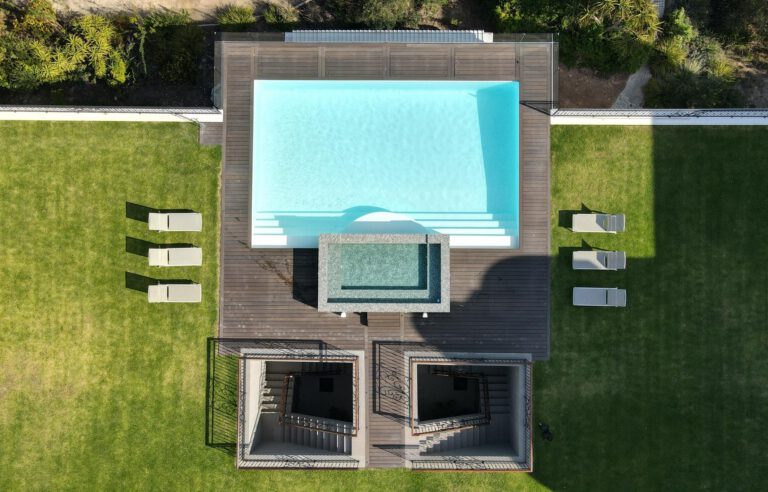
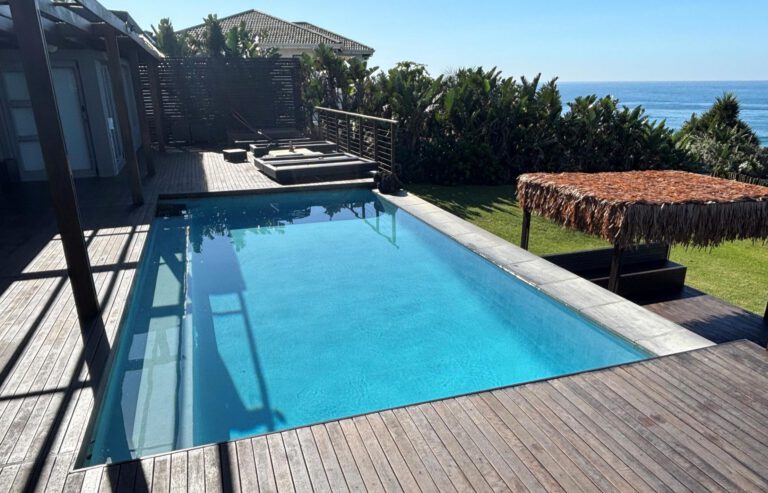
Concrete Swimming Pools in South Africa, built by Horizon Pools (Pty) Ltd, NSPI Gold 2025

HomePool TypesConcrete Pools

Concrete Swimming Pools in South Africa

A concrete pool is a pool whose shell is built on site from steel-reinforced concrete, so it can be made in any shape, size or depth you like.

Built by Horizon Pools (Pty) Ltd — NSPI Gold 2025 Pool Finishing · Western Cape · View this project

What is a concrete pool?

A concrete pool is a swimming pool whose shell is built in place, on your property, from steel-reinforced concrete. A steel cage is tied inside the excavated hole and concrete is either sprayed onto it under pressure — the method South African builders call gunite — or packed on by hand. Once cured, the shell is waterproofed and given an interior finish, usually marbelite: a marble-dust cement plaster about 6–10 mm thick.

Because the shell is formed rather than delivered, a concrete pool can be any shape, depth or size, and can be built into slopes and narrow side passages where a pre-moulded shell could never be craned in. It is the structure behind most South African rim-flow, mosaic and lap pools. As of August 2026 one typically costs R180,000 to R500,000, takes six to twelve weeks to build, and lasts decades — with the interior finish renewed every 10 to 15 years.

Award-winning South African concrete pools

Built here, by builders in this directory

Every pool below won an NSPI award in 2025 in a concrete or gunite category. Each links to the project and to the builder who built it.

A rectangular pool below a Cape Dutch manor, with fynbos-covered hills beyond, built by Radiant Pools, NSPI Platinum 2025 Platinum

A rectangular pool below a Cape Dutch manor, with fynbos-covered hills beyond.

Built by Radiant Pools — NSPI Platinum 2025 Western Cape
A geometric pool pairing a pale blue interior with a navy mosaic waterline band, built by Thatch Crete Gauteng cc, NSPI Platinum 2025 Platinum

A geometric pool pairing a pale blue interior with a navy mosaic waterline band.

Built by Thatch Crete Gauteng cc — NSPI Platinum 2025 Gauteng
A compact plunge pool in a face-brick courtyard, with a slate-clad sheet-flow feature wall, built by Cosmo Pools, NSPI Platinum 2025 Platinum

A compact plunge pool in a face-brick courtyard, with a slate-clad sheet-flow feature wall.

Built by Cosmo Pools — NSPI Platinum 2025 Gauteng
Residential gunite up to 20 m², with a pale marbled interior and sandstone coping, built by Cosmo Pools, NSPI Gold 2025 Gold

Residential gunite up to 20 m², with a pale marbled interior and sandstone coping.

Built by Cosmo Pools — NSPI Gold 2025 Gauteng
Set partly beneath the house in a double-volume undercroft — a site only concrete could take, built by Robust Pools and Paving, NSPI Gold 2025 Gold

Set partly beneath the house in a double-volume undercroft — a site only concrete could take.

Built by Robust Pools and Paving — NSPI Gold 2025 KwaZulu-Natal
A restoration seen from overhead, entered by broad white steps spanning the shallow end, built by Radiant Pools, NSPI Gold 2025 Gold

A restoration seen from overhead, entered by broad white steps spanning the shallow end.

Built by Radiant Pools — NSPI Gold 2025 Western Cape

How it’s built

The ten stages of a concrete pool build

A concrete pool is built in ten stages and takes six to twelve weeks for most South African homes. The longest stage is curing — but good builders run plumbing, coping and paving alongside the cure rather than after it, which is what keeps a shell needing 28 days to reach full strength inside a six-week programme.
  1. Site visit, design and approval

    The builder checks machine access and ground conditions and agrees shape, depth and position with you. Plans go to your municipality — budget for the fees and the delay, because you cannot break ground without approval.

  2. Marking out

    The outline is set out and squared corner to corner before anything is dug. Worth being on site for.

  3. Excavation

    A TLB opens a standard hole in hours. Where access is too narrow for a machine — common on established suburban stands — it is dug by hand, which takes days or weeks and shows up in the price. Rock is the other surprise, and the reason quotes carry a rock clause.

  4. Steel reinforcement

    A cage of mesh and Y8 or Y10 reinforcing bar is tied and held clear of the ground on spacers so concrete surrounds the steel completely — the skeleton that lets a shaped shell carry the water and the earth around it.

  5. Concrete shell

    Concrete is applied over the steel, sprayed under pressure or packed on by hand. Sprayed dry-mix is gunite; sprayed wet-mix is shotcrete. Both give a monolithic shell with no joints for water to find.

  6. Curing

    Concrete gains strength with time, not with drying: about a week before finishing continues, full strength at roughly 28 to 30 days. Plumbing, the weir and lights, the pump and filter, and often coping and paving all happen during this window — which is why the build is far shorter than the cure suggests.

  7. Waterproofing and tiling

    The shell is waterproofed, then any tiling — a mosaic waterline band, a tiled interior, step detailing — is laid and grouted.

  8. Interior finish

    What you see and swim against. Marbelite is the South African default; alternatives are a fibreglass lining over a plaster skim, pebble aggregate, or full mosaic. This choice moves the price more than anything else here.

  9. Surrounds

    Coping, paving, decking, safety fencing, lighting and landscaping — easy to underestimate, and often a separate contractor. Ask early who is doing what.

  10. Fill, start-up and handover

    Filled in one continuous go from the deep end to avoid a tide mark on new plaster, then balanced, commissioned and handed over. A new marbelite surface needs care in its first three weeks — see Maintenance.

Cost guide

What a concrete pool costs in South Africa

As of August 2026, most residential concrete pools in South Africa cost between R180,000 and R500,000 built. Small marbelite pools on easy sites start around R180,000; large custom pools with tiled interiors and vanishing edges run well past R1,000,000.
TierRange (ZAR)What that typically includes
Entry-levelR180,000 – R280,000Roughly 6×3 m to 8×4 m, marbelite interior, sand filtration and a single-speed pump, on a level site with machine access. Excludes paving, decking, fencing and heating.
Mid-range family poolR280,000 – R500,000Roughly 8×4 m to 10×5 m, upgraded finish or a mosaic waterline, better filtration, salt chlorination, LED lighting and a modest paved surround. Where most South African family pools land.
Premium and customR500,000 – R1,500,000+Bespoke shapes, rim-flow edges, fully tiled or pebble interiors, integrated spas, heating, automation and covers, plus the engineering steep sites demand.

Prices last reviewed 8 August 2026.

What moves the price

Two pools of identical size can differ by R150,000, and it is almost never the concrete that does it. As of August 2026:

  • Getting the hole open. Excavation runs roughly R300–R500 per cubic metre, or R12,000–R20,000 for a standard 8×4 m pool. Rock adds R15,000–R50,000, and if a machine cannot reach the back garden, hand digging or a concrete pump (R5,000–R20,000) goes onto the quote.
  • Where you live. Coastal sites typically carry a 5–10% premium; dolomite-risk ground can add 15–25% for the engineering required.
  • The interior finish. The same shell in marbelite, pebble or full mosaic can span the entire entry-to-premium range on its own.
  • Coping, paving and decking. R20,000–R100,000 and up, frequently quoted separately — the most common reason a budget slips.
  • Water treatment and heating. A salt chlorinator adds R8,000–R15,000; a heat pump R15,000–R45,000 installed depending on pool size; solar heating R10,000–R20,000.
  • Covers. Bubble R3,000–R5,000; PVC safety cover R6,000–R15,000; automatic slatted cover R30,000–R45,000 and up.
  • Safety compliance. Fencing is R1,000–R1,500 per metre, or R15,000–R30,000 for a compliant enclosure. Not optional — see the FAQs.
  • Approval and filling. Plans and council fees are commonly R4,000–R15,000, plus an electrical certificate. The first fill of 20,000–50,000 litres costs roughly R1,000–R3,000.

One South African builder’s public advice, and it is sound: take the headline price, add 15–20% contingency, and budget separately for landscaping and decking.

The honest picture

Concrete pools: pros and cons

What concrete does well

  • Any shape, any size, any depth

    The shell is formed on site, so you are not choosing from a catalogue of moulds. Freeform, geometric, split-level, a 1.0 m children’s end and a 2.2 m deep end in the same pool — all normal.

  • It fits sites other pools cannot

    Steep slopes, narrow side passages, courtyards with no crane access, pools that sit partly under a house or on a retaining structure. If a moulded shell cannot physically get there, concrete usually still can.

  • Built to last decades

    A properly engineered reinforced shell has a 50-year-plus life. You maintain the finish on top of it; you do not replace the pool.

  • The structure behind the showpieces

    Rim-flow edges, fully tiled pools, lap pools cut to a specific length, integrated spas and water features are overwhelmingly concrete, because the shell can be shaped to carry them.

  • Repairable and renewable

    Cracks can be repaired, plumbing re-routed, and a tired pool re-finished, re-tiled or reshaped. Restoration is one of the busiest NSPI award categories for exactly this reason — a 30-year-old concrete pool is a candidate for renewal, not demolition.

  • A permanent asset

    A well-built, compliant concrete pool is a fixed improvement to the property rather than an installed product.

The trade-offs

  • It takes longer to build

    Six to twelve weeks, against days for a moulded shell.

    Mitigation: If you are building for a specific December, start the approval process in winter — the municipal step is the one nobody plans for.

  • Higher entry cost

    The lowest-priced concrete pool sits above the lowest-priced pool of other types.

    Mitigation: It buys shape freedom and structural life — but if what you want is a standard rectangle on an easy site, price both routes first.

  • The finish is a consumable

    Marbelite is re-done every 10–15 years, typically R30,000–R60,000 at August 2026 prices.

    Mitigation: Budget it as you would a roof or a geyser; pH discipline is what stretches the interval to the long end.

  • The surface is porous

    Cement-based plaster is not glass-smooth, so it holds algae more readily than gelcoat.

    Mitigation: Regular brushing and stable chemistry, not more chlorine.

  • Chemistry is less forgiving

    Water that drifts acidic or runs low in calcium slowly etches a marbelite surface.

    Mitigation: Test properly rather than by eye, keep calcium hardness in band, and never dump undiluted acid into the pool.

  • A building site in the garden

    Excavation, spoil and delivery access for several weeks.

    Mitigation: Agree spoil removal, access route and working hours in writing before the first cut.

How it compares

Concrete versus the alternatives

The real choice for most South African buyers is concrete versus fibreglass. Concrete gives you shape, depth and site freedom and a shell that outlives the finish; fibreglass gives you speed and a smooth, non-porous surface. Neither is the better pool in the abstract — they are better at different jobs.

Fibreglass Pools

The comparison that decides most projects. A fibreglass pool arrives as a finished moulded shell, can be swimming within one to three weeks of excavation, and has a smooth gelcoat surface that never needs re-plastering. A concrete pool takes six to twelve weeks and its finish is renewed every 10–15 years — but it can be any shape and depth, and built where a shell cannot physically reach. Choose fibreglass for speed and a low-maintenance surface; choose concrete when shape, depth, size or site is the deciding factor. Several NSPI award-winning firms build both.

Infinity Pools (Rim-Flow)

Less an alternative than a concrete pool with a particular edge detail. A rim-flow edge needs a shell engineered for a precisely level lip and a balance tank, which in practice means concrete. If a vanishing edge over a view is what you want, you are choosing a concrete pool.

Lap Pools

A use case rather than a construction method. Lap pools are usually concrete because length is dictated by the site — moulded shells come in fixed sizes, whereas a concrete lane can be built to whatever the property allows.

Maintenance & running costs

Living with a concrete pool in South Africa

Budget roughly R1,200–R2,000 a month to run a family-sized pool in South Africa as of August 2026 — about R300–R600 in pump electricity, R300–R600 in chemicals, and the balance in servicing if you do not do it yourself. Concrete asks for a little more chemical discipline than a moulded shell, because the surface you swim against is made of cement.

The routine

Run filtration long enough to turn the pool over at least once a day — about eight hours for a correctly sized pump, longer in a Highveld summer, less in winter. Brush walls and steps regularly: on plaster, brushing does work that chlorine cannot.

The target band is pH 7.2–7.6, total alkalinity 80–120 ppm, calcium hardness 200–400 ppm and free chlorine 1–3 ppm. Calcium hardness is the parameter people skip and the one that protects the plaster — water low in calcium draws it out of the finish. Salt-chlorinated pools additionally hold 2,500–3,500 ppm of salt.

A new or freshly re-plastered marbelite pool needs special handling in its first month: filled within about 24 hours of the finish going on and filled in one continuous go, pH held slightly high at 7.6–7.8, no acid for three weeks, no automatic cleaner, hand brushing only. Your builder should hand this over as a start-up sheet — follow it, because most marbelite guarantees exclude damage caused by ignoring it.

Beyond that, the recurring cost that matters is re-marbeliting every 10–15 years at roughly R30,000–R60,000. An acid wash, where one is needed, is R2,000–R5,000.

Power and water

Eskom’s April 2026 outlook forecast no load-shedding through the April-to-August winter — a better position than pool owners had grown used to. Localised load reduction and municipal outages still interrupt supply, so run filtration on a timer with battery backup, or an outage silently resets the schedule and the pump stays off for days. A variable-speed pump running longer at lower speed is the standard efficiency upgrade.

Water is now the bigger constraint, and it varies sharply by metro. Check your municipality’s status before you plan a fill or a drain-and-refill. As of early August 2026 Cape Town put dam storage at 78.1% and its status at “Early Drought Caution”, with no numbered restriction level published; Johannesburg approved Level 2 restrictions for high-use areas in February 2026 alongside overnight supply throttling; eThekwini’s last confirmed measure was a bulk-supply curtailment from October 2024, not a pool rule.

Two Cape Town rules apply permanently at every level and are good practice anywhere: a pool must be covered when not in use, and an automatic top-up float valve fed from the municipal supply is not permitted. A cover is the highest-return purchase a South African pool owner can make.

Regional realities

On the Highveld, summer storms drop a season’s worth of leaf litter into a pool in an afternoon, and winter nights are cold enough that most owners go dormant rather than heat. In the Cape, the south-easter drives both debris and evaporation. On the KwaZulu-Natal coast, a year-round season means a chemical bill that never gets a winter break, and salt air working on any metalwork.

Salt versus chlorine

A salt chlorinator does not replace chlorine; it manufactures it, passing a low salt solution through an electrolytic cell. Owners generally find the water gentler on eyes and skin and the routine less hands-on, at the cost of a higher up-front spend and a cell that is eventually replaced.

On a concrete pool the honest position is this: salt held in band with pH under control is not a problem for marbelite. What needs attention is metalwork — ladders, rails, light surrounds and fixings — and soft porous coping such as limestone or travertine. Rinse surrounds with fresh water, seal porous stone, specify good stainless steel. Over-salting and acidic drift are what turn a salt pool into a maintenance problem, not the salt.

Questions buyers actually ask

Concrete pool FAQs

What does a concrete pool cost in South Africa?

As of August 2026, most residential concrete pools cost between R180,000 and R500,000 built. An entry-level 6×3 m to 8×4 m marbelite pool on a level site with machine access runs R180,000–R280,000; a mid-range family pool R280,000–R500,000; premium and custom builds from R500,000 to well over R1,000,000. These are planning ranges, not quotes — price is driven as much by access, ground conditions and finishes as by size.

How long does it take to build a concrete pool?

Six to twelve weeks from breaking ground to swimming, plus time before that for design and municipal approval. Rain, difficult access, rock and retaining work are the usual delays. The concrete needs about a week before finishing continues and reaches full strength at around 28 days, but good builders run plumbing, coping and paving during that window rather than after it.

How long does a concrete pool last?

The reinforced shell is a structural element with a 50-year-plus life. What wears out is the interior finish: marbelite is typically re-done every 10 to 15 years, at around R30,000–R60,000 as of August 2026. Stable water chemistry — particularly pH and calcium hardness — is what pushes that interval towards the long end.

Concrete or fibreglass — which should I choose?

It depends on which constraint matters most. Choose fibreglass if you want to be swimming in weeks rather than months, want a smooth non-porous surface that never needs re-plastering, and one of the moulded shapes suits your garden. Choose concrete if you want a specific shape, size or depth, if your site is steep or access too tight to bring a shell in, or if you want a rim-flow, lap or fully tiled pool. Several award-winning firms build both.

Do I need council approval to build a pool?

Yes. Plans go to your municipality before construction, and a compliant safety barrier is a legal requirement, not a preference. The national building regulations require an enclosure at least 1.2 m high with no gap that would pass a 100 mm ball, and a self-closing, self-latching gate that can be locked. Many municipalities go further, so check your by-laws — non-compliance is an offence. Budget R4,000–R15,000 for plans and council fees, plus an electrical certificate.

What does it cost to run a concrete pool each month?

Roughly R1,200–R2,000 a month all-in as of August 2026 for a family-sized pool: about R300–R600 in pump electricity, and R300–R600 in chemicals if you dose it yourself, or R500–R1,200 for a monthly service instead. Costs rise in summer and drop in winter, and a cover meaningfully reduces both evaporation and heat loss.

Is a salt pool a good idea on a concrete shell?

Yes, provided salt is held around 2,500–3,500 ppm and pH stays in band — at the correct concentration salt is not a problem for a marbelite finish. What needs attention is metalwork in and around the pool, where salt accelerates corrosion, and soft porous coping such as limestone or travertine. Rinse surrounds with fresh water, seal porous stone, and specify good stainless steel.

Can a concrete pool be built on a slope or a tight site?

This is where concrete does its best work. Because the shell is formed in place it can be built into a slope, cantilevered over a retaining structure, tucked under a house, or squeezed down a narrow side boundary — sites where a moulded shell cannot be craned in. Expect engineering and access costs on top of the base price, and get a builder with structural experience onto the site before you commit to a design.

Featured builders

Concrete pool builders in South Africa

Builders with an award-winning pool of this type first, then by featured rank. Award counts shown are NSPI awards in concrete and gunite categories.

Featured builder

Cosmo Pools

Centurion · Gauteng

Cosmo Pools manufactures composite fibreglass pool shells at its own plant and installs them across Gauteng, from Centurion and Pretoria out to Hartebeespoort. Choose a shape from the range, get an instant online estimate, and the team handles delivery, installation and salt-chlorination.

1 Platinum 3 Gold 7 Silver 4 Bronze
NNSPI member View profile →

Summer Pools

Bloubergstrand · Western Cape

Summer Pools has been building, renovating and maintaining Cape Town pools since 1996, from a base in Table View. Rim-flow pools are the speciality, alongside lap pools and family pools with water features, finished in mosaic tile, marble plaster or fibreglass.

1 Silver
NNSPI member View profile →

Horizon Pools (Pty) Ltd

Bloubergstrand · Western Cape

Horizon Pools manufactures and installs fibreglass pool shells from Strand, serving Cape Town and the wider Western Cape. Relining of old concrete and fibreglass pools, plunge pools, hot tubs, water features, covers, nets, solar heating and mosaics all come off the same team.

2 Gold 1 Silver
NNSPI member View profile →

Robust Pools and Paving

Ballito · KwaZulu-Natal

Robust Pools has been building pools in Durban since 1988, working across eThekwini and the KwaZulu-Natal coast. Gunite and pre-formed fibreglass pools, rim-flow pools, renovations of older pools, and the paving and water features that go with them.

2 Gold 5 Silver
NNSPI member View profile →

Oasis Pools builds, remodels and maintains swimming pools, spas and saunas across Zambia, with branches in Lusaka and Kitwe. The team also installs and repairs pumps, filters and pool equipment, and stocks chemicals and spa products in its retail shops.

2 Gold 1 Silver 5 Bronze
NNSPI member View profile →

Kenny Matthews Pools cc

Ballito · KwaZulu-Natal

Kenny Matthews Pools builds, repairs and maintains pools along the KwaZulu-Natal north coast, from Salt Rock and Sheffield Beach through Ballito. Gunite construction for homes on tight coastal sites, and one of the most awarded builders in the country.

13 Gold 10 Silver 2 Bronze
NNSPI member View profile →
See all 88 concrete pool builders

Filter by province, budget, NSPI membership and award history.

Get quotes for your concrete pool

Tell us about your site and we’ll put you in front of concrete pool builders who work in your area. Free, and no obligation.

P

About this guide. PoolBuilders.co.za has been South Africa’s online swimming pool directory since 2004. Cost ranges on this page were researched from current South African builder and supplier pricing and last reviewed on 8 August 2026; they are published as ranges, never point prices, and are reviewed annually and whenever a featured builder tells us they are wrong. Every photograph is a real project from a builder listed in this directory, credited by name. Tell us something is wrong