Lap Pools in South Africa, built by Cosmo Pools, NSPI Platinum 2025

HomePool TypesLap Pools

Lap Pools in South Africa

A lap pool is a long, narrow pool built for swimming lengths rather than lounging in — one uninterrupted lane, usually of a single depth, and in South Africa usually somewhere between 10 and 20 metres long.

Built by Cosmo Pools — NSPI Platinum 2025 Highest Score in Category 1 · Gauteng · View this project

What is a lap pool?

A lap pool is a swimming pool shaped around one activity: swimming lengths. It is long, narrow, normally a single depth from end to end, and sized so an adult can hold a proper stroke without stopping. Lap is a use case, not a construction method — the same pool can be a concrete shell built on site to whatever length your property allows, or a moulded fibreglass shell in a fixed factory size.

So how long does it need to be? Length buys one thing: fewer turns. Any pool you can push off in will let you swim; a shorter one simply makes you stop more often. Swimming a kilometre takes 39 turns in a 25 m pool, 66 in a 15 m pool and 83 in a 12 m one. The only two sources that publish a floor — one South African, one American — both put it at about 12 metres, and 12 to 15 metres is where most residential lanes sit. Below roughly 10 metres the usual answer is a swim jet rather than a longer pool.

Width matters more than buyers expect. A comfortable single lane is about 2.5 to 3 metres — narrower and your hands find the wall. Depth is normally uniform at around 1.2 to 1.4 metres, so there is no shallow end to interrupt the swim.

One South African constraint decides the route before anything else: no moulded shell longer than about 10 metres is made here. Above that, a lap pool is a built pool.

---

Award-winning South African lap pools

Built here, by builders in this directory

Every pool below won an NSPI award in a lap pool category. Each links to the project and to the builder who built it.

A three-lane pool on a Cape estate, with lane markings set into the floor, built by Horizon Pools (Pty) Ltd, NSPI Gold 2025 Gold

A three-lane pool on a Cape estate, with lane markings set into the floor.

Built by Horizon Pools (Pty) Ltd — NSPI Gold 2025 Western Cape
A long lane along a KwaZulu-Natal clifftop, the surf breaking on the rocks below it, built by Robust Pools and Paving, NSPI Gold 2025 Gold

A long lane along a KwaZulu-Natal clifftop, the surf breaking on the rocks below it.

Built by Robust Pools and Paving — NSPI Gold 2025 KwaZulu-Natal
A lane beside lawn and chequerboard paving, with a glass balustrade running the far edge, built by Cosmo Pools, NSPI Gold 2025 Gold

A lane beside lawn and chequerboard paving, with a glass balustrade running the far edge.

Built by Cosmo Pools — NSPI Gold 2025 Gauteng
A narrow lane between raised concrete walls, shaded and green with reflected planting, built by Radiant Pools, NSPI Gold 2025 Gold

A narrow lane between raised concrete walls, shaded and green with reflected planting.

Built by Radiant Pools — NSPI Gold 2025 Western Cape
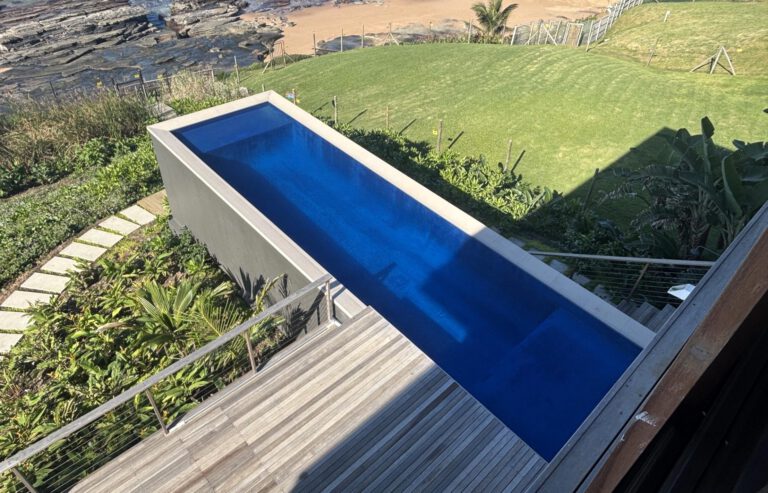
A deep blue lane cantilevered out over the slope, reached across a stone-flagged path, built by Kenny Matthews Pools cc, NSPI Silver 2025 Silver

A deep blue lane cantilevered out over the slope, reached across a stone-flagged path.

Built by Kenny Matthews Pools cc — NSPI Silver 2025 KwaZulu-Natal
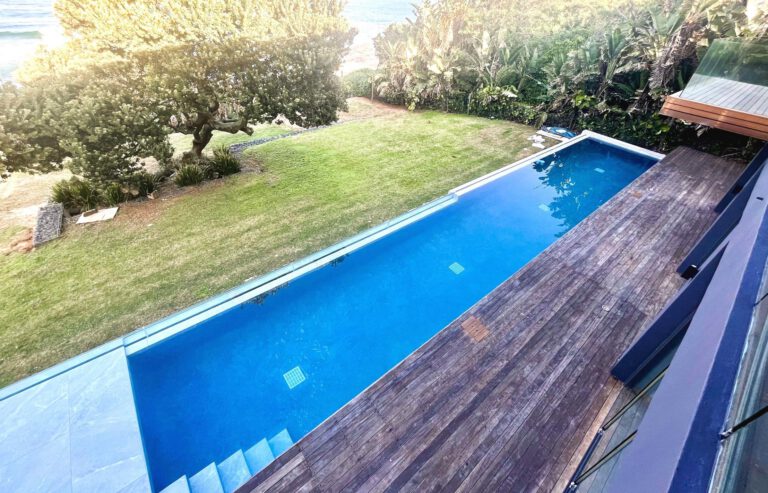
A dark-water lane edged in timber decking beneath an established tree, built by Kenny Matthews Pools cc, NSPI Bronze 2025 Bronze

A dark-water lane edged in timber decking beneath an established tree.

Built by Kenny Matthews Pools cc — NSPI Bronze 2025 KwaZulu-Natal

How it's built

How a lap pool gets built

Building a lap pool is building a normal pool with three decisions made earlier and taken more seriously: how long the lane is, whether it fits between your boundary and your building line, and how it will be heated. Get those three right and the rest is ordinary pool construction.
  1. Decide the length, and accept the turn count

    Everything follows from this. Measure the clear run you actually have, remembering that a 25 m lane needs roughly 26 to 27 metres of ground once coping at both ends is allowed for. Then decide honestly what you will swim: a kilometre is 39 turns at 25 m, 66 at 15 m and 83 at 12 m. Turns are not a defect — they are the price of a pool that fits.

  2. Fit it to the stand — boundary and building lines

    This is the step that catches lap pools specifically, because they go down side boundaries. A pool's position relative to your boundary and building lines is exactly what determines how much scrutiny your plans get; in Johannesburg it is a documented plan trigger. Check your own municipality's by-law before a designer draws anything, because the answer can shorten the lane or move it off the boundary entirely.

  3. Survey the access down the narrow side

    The other lap-specific step. A lane down a side boundary usually means a route a TLB cannot use. Machine excavation opens a standard hole in hours; hand digging takes days or weeks and shows up in the price. Settle now who removes the spoil and along which route, what happens to the neighbour's wall, and — if you are considering a moulded shell — whether a crane can reach and swing over the house. Get this done before you pay a deposit.

  4. Choose the route — built to length, or a moulded shell

    Three South African shell suppliers we could check top out at 10 m, and none makes a shell marketed as a lap pool. So: under 10 m, both routes are open and fibreglass is the faster one; over 10 m, you are building a concrete lane. Width is the other fork — see pt_cost_drivers for why a genuinely comfortable lane width and routine road transport do not overlap neatly.

  5. Build or place the shell

    From here it is standard construction for whichever route you chose: a formed, steel-reinforced shell on the concrete route, or excavation, base preparation, delivery, crane placement and simultaneous fill-and-backfill on the fibreglass route. Neither page's process changes because the pool is long.

  6. Detail the swimming end of it

    The part a general pool builder may not think about. Keep the depth uniform so there is no shallow-to-deep transition mid-length. Ask where the steps, the skimmer and the ladder are going, and whether they can sit anywhere other than a wall you will be pushing off sixty times a session. If you want a lane line on the floor, specify it now — it is set into the finish, not added later.

  7. Heating, cover and plant — decided now, not later

    On this type these are not accessories. Filtration is sized to the volume, which on a long lane is often more water than the builder's default pump assumes. Heating and a cover work as a pair and both need to be in the design: pipe runs, a plant position, the electrical supply for a heat pump, and roof or ground area if you are going solar. Retrofitting all of it later costs more and looks it.

  8. Fill, commission and find your temperature

    Fill, balance and commission as on any pool. Then set the water temperature you will actually swim at rather than the one that feels nice to stand in — the published band for lap swimming is 26 to 28 °C, and every degree above it is money.

Cost guide

What a lap pool costs in South Africa

As of August 2026, a lap pool in South Africa costs much what any pool of the same water area costs — with a modest penalty for the shape, because a long thin pool has more wall, more edge and more coping per litre than a square one. Expect roughly R180,000 to R400,000 for a moulded shell lane up to 10 m, R350,000 to R650,000 for a concrete lane built to 12–16 m, and more beyond that. No South African builder publishes lap-pool pricing, so treat these as planning ranges built from the wider market rather than as a surveyed price list.
TierRange (ZAR)What that typically includes
Moulded shell lane, up to 10 mR180,000 – R400,000The fastest route, and the only one with a factory price. A pre-formed fibreglass shell at the long end of what South African manufacturers make, installed: excavation, base preparation, delivery, crane placement, plumbing, pump and filter, ring beam and coping. Excludes paving, fencing, heating and a cover. Shell width — not length — is what pushes this range around.
Concrete lane built to length, 12–16 mR350,000 – R650,000Where most serious lap pools land. A steel-reinforced shell formed on site to the length your property allows, marbelite or tiled, uniform depth, filtration sized to the volume, and a paved surround along both long sides. This is the tier where the extra perimeter of a long pool is actually paid for.
Long lane, hard access, or fully specified for year-round useR650,000 – R1,200,000+An 18–25 m lane, or a shorter one on a site where the machines cannot get down the side, or one specified as the year-round pool it was bought to be: heat pump or solar, an automatic cover, a tiled interior, a lane line, automation. No South African source prices a 20–25 m residential lane at all — this tier is extrapolated from the concrete premium band and should be read as a planning bracket, not a quote.

Prices last reviewed 8 August 2026.

What moves the price

Two things drive a lap pool's price that do not drive a conventional one, and one South African constraint decides which pool you can buy at all. As of August 2026, and noting up front that no South African cost source states whether its figures include VAT — worth about R65,000 on a R500,000 pool:

  • The shape costs money, and the mechanism is edge. For the same area of water, a 12 m × 2.5 m lane has about 23% more perimeter than a squarer pool of the same size, and a 15 m × 2.5 m lane about 35% more (our arithmetic — the geometry is not in dispute, but nobody publishes it). More perimeter is more wall to build, more coping to buy and more paving to lay along it. One Cape Town builder states the principle plainly — "coping is priced largely by linear metre of edge … the running metres add up quickly" — and then, like every other South African source, publishes no per-metre rate. Ask for coping and paving quoted per linear metre rather than as a lump sum. On a long pool that single line is worth arguing about.
  • Nobody in South Africa prices pools by the metre. Every SA source publishes whole-pool bands or size-category bands: no rate per square metre, per cubic metre or per metre of length. The closest thing found is one Cape Town installer's fibreglass ladder, which rises from roughly R66,000–R85,000 at 4 m to R107,000–R129,000 at 10 m — about R7,000 per additional metre of shell (our arithmetic on their ladder; that source was excluded from the Fibreglass pack for internal inconsistency, so read it as a direction of travel, not a rate). Notably, on the same ladder the width band barely moves the price while the length band does.
  • Width is where South African transport bites, and it collides with what makes a lane swimmable. A load over 2,600 mm wide is an abnormal load in South Africa, requiring a provincial permit and a route assessment. A comfortable single swimming lane is 2.5 to 3 metres. One SA manufacturer asks buyers to phone before ordering anything over 3 m wide, and mentions permits and route access in the same breath. Read those two facts together and the conclusion is uncomfortable but useful: the width at which a moulded lane becomes genuinely comfortable to swim in is very close to the width at which delivering it stops being routine. (That is our reasoning from two sourced facts, not a claim any source makes — but it is the practical reason most SA lap pools are built rather than delivered.)
  • Getting down the side of the house. Excavation runs R300–R500 per cubic metre, and a lane holds a lot of cubic metres. Where a machine cannot reach, hand digging turns hours into days or weeks. Rock adds R15,000–R50,000. A crane lift over a house is commonly R5,000–R15,000 on a metro job, with SA crane hire running from about R4,000 a day to R25,000 for heavy tonnage, and a lift staged from a public street needs a municipal road-closure permit with five to ten working days' notice.
  • The year-round kit, which on this type is not optional. A heat pump is R15,000–R45,000 installed; solar pool heating R10,000–R20,000 by one source and R15,000–R45,000 fitted by another (they disagree — get both quoted); covers from R3,000 for a bubble cover to R30,000–R45,000 and up for an automatic slatted one. If year-round swimming is the reason you are buying this pool, put these in the build budget, not the wish list. Then read the running costs below, because that is the number that decides whether the pool gets used in July.
  • The swim-jet alternative, honestly. A counter-current system in a short pool is a real route and there is a real South African supply channel for it — Speck Pumps South Africa lists six BADU JET models locally, three submerged and three hang-on-the-wall, at 2.2 to 3 kW. But no South African supplier publishes a price for one. The only ZAR figure we could find anywhere is R30,000–R75,000, from the competing directory described in the appendix, and we are not treating that as market pricing. Get a written quote before you plan around it.
  • The ordinary rest of it, unchanged from any pool: coping and paving R20,000–R100,000 and up; salt chlorinator R8,000–R15,000; plans and council fees R4,000–R15,000 plus an electrical certificate; a compliant fence R1,000–R1,500 per metre or R15,000–R30,000 — not optional, and a long pool has a long fence.

The honest picture

Lap pools: pros and cons

What a lap pool does well

  • It is a pool with a purpose

    Most pools are bought for a feeling and used for three months. A lap pool is bought for an activity, and the people who buy them tend to be the people who use them. If your reason for wanting a pool is exercise, this is the shape that serves it.

  • It fits stands that defeat other pools

    A long narrow footprint down a side boundary or along the back of a stand uses ground that a conventional pool cannot. On a narrow suburban erf, the lane is often the only pool the property will take.

  • Uniform depth is simpler and safer

    No shallow-to-deep transition mid-length means nothing interrupts the swim, and the whole pool is a depth an adult can stand in. It also removes the diving question from the design entirely.

  • Less water than the length suggests

    Length is not volume. A 12 m × 2.5 m lane at 1.3 m deep holds about 39,000 litres — less than a conventional 8 × 4 m family pool (our arithmetic). Fewer litres is less to heat, less to treat and less to replace, which matters on a pool that runs all year.

  • Either construction route can deliver it

    Under about 10 metres you have a genuine choice: a moulded fibreglass shell is the faster, more predictable route, and a concrete shell built on site is the one that removes the length and shape limits. Over 10 metres the choice is made for you. Award-winning South African firms build both.

  • It is a strong line in a garden

    A long straight lane reads as architecture rather than as a feature — it works with a boundary wall, a hedge or the edge of a house in a way a freeform pool does not, and it is the easiest shape to light well.

The trade-offs

  • Turns, and a lot of them

    Below about 15 metres you spend a real share of every session turning rather than swimming — 83 turns in a kilometre at 12 m against 39 at 25 m.

    Mitigation: Be honest with yourself about the distance you will actually swim, and price a counter-current jet against the cost of the extra metres. On a short lane the jet is the feature that makes the pool work.

  • It is not a family or party pool

    Narrow, uniform-depth and long is the wrong shape for children playing, for a crowd, or for sitting in.

    Mitigation: South African builders do widen one end or add a ledge, steps or a spa to a lane. Say so at design stage — it changes the layout, not the price much.

  • The shape costs more per litre

    More perimeter means more wall, more coping and more paving for the same volume of water.

    Mitigation: It is a modest penalty, not a different price bracket. Keep the coping specification simple and get it quoted per linear metre.

  • Heating stops being optional

    A pool bought for year-round exercise that is too cold to use from May to September has failed at its one job — and heating a long lane through a Highveld winter is a four-figure monthly cost, not a rounding error.

    Mitigation: Budget the running cost before the capital cost, and treat a cover as part of the heating system rather than an accessory. See Maintenance.

  • Narrow access is where the money hides

    The same side boundary that makes the pool possible is what keeps the machines out — hand excavation, spoil carried by wheelbarrow, and no crane swing for a delivered shell.

    Mitigation: Get an access survey before a deposit changes hands, and ask for excavation and spoil removal as separate lines.

  • Boundary and building lines can shorten it

    The lane wants to sit where the by-law is most interested.

    Mitigation: Check your municipality's boundary and building-line rules before the design, not after — it is cheaper to discover a metre missing on paper.

How it compares

Lap pools versus the alternatives

A lap pool is not an alternative to concrete or fibreglass — it is a shape, and you can have it in either. The question is not "which type", it is "how long a lane do I want, and which route will give me that length on this property".

Concrete Pools

One of the two routes to a lap pool, and the only one above about 10 metres. Because the shell is formed on site, the lane can be exactly as long as the property allows, at a uniform depth, squeezed down a side boundary where nothing could be craned in. It takes six to twelve weeks rather than days, and the interior finish is renewed every 10–15 years. If length is the point, read the concrete pools guide.

Fibreglass Pools

The other route, and the faster one — a moulded shell installed in seven to ten working days with a smooth non-porous surface that never needs re-plastering. The constraint is the mould: the longest shells any South African manufacturer we could check produces are about 10 m, and none is marketed as a lap pool, so the narrower long shells are what you are choosing between. If your lane fits inside 10 metres, fibreglass is a genuinely quick way to get it.

Infinity Pools (Rim-Flow)

A natural partner rather than an alternative. A lane already has the longest straight wall on the property, which is the easiest lip to build level and the most striking to swim towards. A rim-flow edge adds a balance tank, a second pump circuit and the engineering to carry a millimetre-accurate lip — so it adds meaningfully to both the build and the running cost of a pool that is already the one you run all year.

Mosaic Pools

A finish rather than a structure, and the one that matters most on this type. A lap pool has more wall than any other shape per litre of water, so the interior finish decision is amplified — and a tiled lane line, if you want one, is a mosaic job. Mosaic is the most expensive interior option and the most durable.

Maintenance & running costs

Living with a lap pool in South Africa

A lap pool is the one type where the running cost, not the build cost, decides whether the purchase was a good one. It is bought for year-round exercise, which means it never gets a winter off — the filtration runs, the chemicals get used, the water evaporates, and from about May the water is too cold to swim in unless you heat it. Heating a 15-metre lane through a South African winter is realistically R1,600 to R3,000 a month on top of everything else. That number is the whole argument of this section, and almost nobody in the South African industry publishes it.

Heating — the cost that defines this type

No South African source publishes a defensible monthly running cost for pool heating. That is a firm finding, not a gap in our searching: every SA heat-pump supplier reached sells on purchase price and coefficient of performance, and none costs a winter month. The one exception is a solar and heat-pump company that puts a 50,000-litre pool on a COP-5 heat pump at R300 a month — with no tariff, no run hours and no target temperature stated, and undated. Rebuilt at 2026 electricity prices that figure does not survive contact with arithmetic, and we are not repeating it.

So here is the arithmetic, shown in full so you can substitute your own pool. These are our calculations on published South African inputs, not a figure anyone publishes.

A 15 m × 3 m lane at a uniform 1.4 m holds 63,000 litres. South African suppliers size a 13 kW heat pump for 30,000–55,000 litres, which puts a lane that size in roughly the 17 kW class — and one SA distributor adds about 15% to standard sizing for Johannesburg's altitude, so call it 19–20 kW on the Highveld. A 17 kW unit at the COP of 5 that SA suppliers quote draws about 3.4 kW of electricity. At R4.00/kWh:

| Running the heat pump | Electricity used | Cost per month | |---|---|---| | 4 hours a day | 408 kWh | ~R1,630 | | 6 hours a day | 612 kWh | ~R2,450 | | 8 hours a day | 816 kWh | ~R3,270 |

Two warnings about those numbers. First, COP is quoted at summer conditions — the 13 kW unit we found publishes COP 9 measured at 26 °C air and 26 °C water. No South African supplier publishes a COP at the 0–10 °C ambient of a Highveld July, which is exactly when you need it, so the real winter figure is worse than the table. One SA distributor does claim its inverter units run down to −7 °C, which is a different and more useful claim than a headline COP. Second, filtration is on top: the standard 1.1 kW pump at eight hours a day is about R1,050 a month at 2026 prices, and a lane holds more water than a family pool, so eight hours is the realistic number rather than six.

The cover is not an accessory, it is part of the heating system. One South African supplier — who sells both heat pumps and blankets, and therefore has an interest in selling the bigger unit — states that without a thermal pool blanket the heat pump has to be two to three times larger. Taken at face value, that means a cover removes roughly half to two-thirds of the heating demand. On the table above, that is the difference between a pool you run and a pool you switch off in June. South African cover suppliers claim a GeoBubble thermal cover cuts evaporation by 98%, and that a solar cover lifts water temperature by 5–10 °C — vendor claims, uncorroborated, but pointing the same way.

Solar heating extends the season; it does not replace the heat pump. A South African pool-equipment brand is unusually straight about this: on the Highveld, "a solar pool heater alone usually covers eight to ten months, and a heat pump fills the gap on the coldest days." Sizing is roughly 60–80% of the pool's surface area in panels in a warm region like KwaZulu-Natal, closer to 100% in cooler ones — and a lap pool has a lot of surface area to match. Running cost is essentially just the booster pump, though no SA source quantifies even that. If you swim all year on the Highveld, the honest configuration is solar for most of it and a heat pump for July, with a cover over both.

And set the temperature for the swim you are doing. The published band for lap swimming is 26–28 °C — a South African heat-pump distributor and an American pool builder independently agree on it. Recovery and technique swimming is done at 30–31 °C, which is three or four degrees warmer and costs accordingly. An exercise swimmer heating to lounging temperature is paying for water they do not want.

Power, and the tariff that changed

South African electricity is materially more expensive than it was when most pool-running-cost content was written. Eskom's standard tariffs rose 8.76% from 1 April 2026 and municipal tariffs 9.01% from 1 July 2026; the City of Cape Town's published domestic rate is 390.94 c/kWh including VAT on its current schedule, with a secondary source putting the July 2026 domestic rate at 413.79 c/kWh. Every figure on this page uses R4.00/kWh as the 2026 working rate. If you are reading an older pool running-cost figure anywhere — including on our own other pool-type pages until they are updated — check what tariff it was built on.

Supply itself is in better shape than pool owners are used to: Eskom's April 2026 outlook forecast no load-shedding through the April-to-August winter. Municipal outages have not gone away, so run filtration and heating on a timer with battery backup, or an outage silently resets the schedule and the pump stays off for days.

A counter-current jet, if you have one, is cheap to run by comparison. The South African units are 2.2–3 kW, so a 3 kW jet used for a 30-minute swim every day is about R180 a month at 2026 prices (our arithmetic). Against R2,450 for the heat pump, the jet is not the expensive part of a lap pool — the warm water is.

Water — no winter off, and a heated surface that keeps evaporating

A pool used all year is topped up all year. An SA contractor puts general pool evaporation at 35–45 mm a week in summer and credits a cover with cutting it 90–95%. On a 15 × 3 m lane, 40 mm a week across 45 m² of surface is 1,800 litres a week, close to 8,000 litres a month (our arithmetic) — and a heated pool goes on evaporating in winter, when an unheated one has largely stopped. Nobody in South Africa publishes winter evaporation from a heated pool; treat it as a real cost that no source will quantify for you.

Restrictions vary sharply by metro and change — as of early August 2026 Cape Town was under an "Early Drought Caution" with dams at 78.1%, Johannesburg on Level 2 for high-use areas, and eThekwini on a bulk-supply curtailment rather than a pool rule — so check yours before you plan a fill. The lap-specific point is that you will be checking more often than other pool owners, because a heated pool tops up in July as well as January. And the first fill is larger than the sources assume: SA cost pages price a fill of 20,000–50,000 litres at R1,000–R3,000, and a 15-metre lane holds more than that.

Two City of Cape Town rules apply permanently, not at a restriction level, and are good practice anywhere: a pool must be covered when not in use, and an automatic top-up float valve fed from the municipal drinking water supply is not permitted. For a lap-pool owner the first of those is the rare case where a regulation and your own interest point the same way — the cover you are required to have is the same cover that halves your heating bill. The second means topping up by hand, all year, on a pool that never stops losing water.

Year-round chemistry, and the thing nobody writes about

South African winter maintenance advice is consistent and sensible: run the pump six to eight hours a day in winter against eight to twelve in summer, do not shut down — "water that circulates cannot stagnate" — hold free chlorine at 1–3 ppm (lower demand than summer because there is less UV breaking it down), pH 7.2–7.6, alkalinity 80–120 ppm, and test every two or three weeks rather than weekly. In frost-prone Highveld areas, run the pump overnight so the water in the pipes keeps moving.

But all of that advice assumes a cold winter pool, and a heated lap pool is not one. A lane held at 27 °C in July is, chemically, a summer pool: warmer water means faster chlorine consumption and more biological activity, and it needs summer filtration hours, not winter ones. No South African source addresses this at all — the winter guidance the whole local industry publishes is written for a pool nobody is swimming in. Budget for summer chemistry twelve months a year rather than the seasonal saving other pool owners get, and expect your own numbers to differ from any published winter figure.

Wind, and where in the country you swim

A long thin pool is mostly edge, which makes it the shape most exposed to wind — you swim into whatever the surface is doing for the full length, and there is no wide middle for the chop to die down in. In the Cape, mean wind runs from about 3 m/s in the calm months to about 6 m/s in January, so an exposed lane is a genuinely different swim from a sheltered one. No South African or international source we could find addresses lane orientation, windbreaks or the Cape south-easter in relation to pool design — so ask your builder and your landscaper which way the lane should run, and treat any confident answer as experience rather than published guidance.

Regionally, for someone who swims every day: on the Highveld, solar carries eight to ten months and July is the month that decides whether you bought a heat pump, with frost protection on the plumbing as well. In the Cape, winter rainfall does some of the topping up that Johannesburg and Pretoria have to do by hand, but the wind is the daily variable. On the KwaZulu-Natal coast, the season is already close to year-round and the heating question is the least urgent in the country — the trade-off is a chemical and filtration bill that never gets a break, and salt air working on any metalwork around a long pool.

---

Questions buyers actually ask

Lap pool FAQs

How long does a lap pool need to be?

Long enough that the turns do not annoy you, which is a more personal answer than buyers expect. Length buys nothing except fewer turns: swimming a kilometre takes 39 turns in a 25 m pool, 66 in a 15 m pool and 83 in a 12 m one. The only two published sources that give a floor — one South African, one American — both put it at about 12 metres, and 12 to 15 metres is where most residential lanes sit. Below roughly 10 metres, a counter-current swim jet is usually the better answer than more length. Allow about 26 to 27 metres of clear ground if you genuinely want a 25 m lane, once coping at both ends is counted.

How wide and how deep should a lap pool be?

About 2.5 to 3 metres wide and a uniform 1.2 to 1.4 metres deep for a single lane. Width is the dimension buyers cut to save space and the one they most regret: a competition lane is at least 2.5 m for a reason, and narrower than that your hands start finding the wall on a full stroke. Depth is normally kept uniform end to end so there is no shallow-to-deep transition mid-length, and 1.2–1.4 m is deep enough to swim and turn properly while still being standing depth for an adult.

What does a lap pool cost in South Africa?

As of August 2026, roughly R180,000–R400,000 for a moulded fibreglass shell lane up to 10 m installed, R350,000–R650,000 for a concrete lane built to 12–16 m, and R650,000 upwards for a longer lane, a difficult narrow site or a pool fully specified for year-round use. Be aware that no South African builder publishes lap-pool pricing — these are planning ranges built from the wider market and adjusted for the shape, not a surveyed price list. Ask every quote whether it includes VAT and get coping and paving quoted per linear metre, because a long pool has a lot of edge.

Is a shorter pool with a swim jet better than a longer pool?

It is a real alternative, and on a stand that cannot take length it is the only one. A counter-current system lets you swim continuously in a pool far too short to swim lengths in, and it costs very little to run — the South African units are 2.2–3 kW, so a daily half-hour swim is around R180 a month. The honest caveat is that there is almost no published South African market information: local suppliers list the units but none of them publishes a price, so you cannot compare the jet against the extra metres without getting written quotes for both. Get those quotes before you design around either.

What does it cost to heat a lap pool for year-round swimming?

Realistically R1,600 to R3,000 a month for a 15-metre lane, plus about R1,050 for filtration. That is our own arithmetic on published South African figures — a 63,000-litre lane needs roughly a 17 kW heat pump, which draws about 3.4 kW at the coefficient of performance local suppliers quote, at around R4.00 per kWh in 2026. No South African supplier publishes a monthly running cost, and the coefficients they do publish are measured in summer conditions, so a Highveld July will be worse than the calculation. A thermal cover is the single biggest lever: one supplier states that without one the heat pump has to be two to three times larger.

Can a lap pool go down the side boundary of my property?

Often yes, and that is exactly why people build them — but the boundary is what triggers the scrutiny. Where a pool sits relative to your boundary and building lines determines how your plans are assessed, and in Johannesburg it is a documented plan trigger; other municipalities set their own rules, so check your by-law before anything is designed. The other side-boundary question is practical rather than legal: whether a machine can get down there at all. Hand excavation and wheelbarrowed spoil are what a narrow side costs, and a delivered fibreglass shell needs crane access on top. Get both questions answered before you pay a deposit.

Concrete or fibreglass for a lap pool?

Length decides it. No South African manufacturer we could check makes a moulded shell longer than about 10 metres, and none markets one as a lap pool — so if you want more than 10 metres of lane, you are building a concrete shell on site. Under 10 metres you have a genuine choice: fibreglass is faster, about seven to ten working days on site, with a smooth non-porous surface; concrete takes six to twelve weeks and lets you set the exact length, width and depth, and reach sites a crane cannot. Award-winning South African firms build both, and several build both routes as lap pools.

Do South African builders do a tiled black lane line?

It is not an off-the-shelf product here. We could find no South African tile or mosaic supplier listing lane-line, racing-line or turn-target tiles — local pool tile ranges are decorative, waterline and coping products — so a lane line in South Africa is a custom mosaic layout your builder sets out, not a catalogue item. If you want one, the competition specification is a useful brief to hand over: a dark contrasting line 200–300 mm wide down the centre of the lane, ending 2 metres short of each end wall with a 1-metre cross line, plus a target line on the end wall itself. Specify it at design stage, because it goes into the finish rather than onto it.

Featured builders

Lap pool builders in South Africa

Builders with an award-winning pool of this type first, then by featured rank. Award counts shown are NSPI awards in lap pool categories.

Featured builder

Cosmo Pools

Centurion · Gauteng

Cosmo Pools manufactures composite fibreglass pool shells at its own plant and installs them across Gauteng, from Centurion and Pretoria out to Hartebeespoort. Choose a shape from the range, get an instant online estimate, and the team handles delivery, installation and salt-chlorination.

1 Platinum 3 Gold
NNSPI member View profile →

Horizon Pools (Pty) Ltd

Bloubergstrand · Western Cape

Horizon Pools manufactures and installs fibreglass pool shells from Strand, serving Cape Town and the wider Western Cape. Relining of old concrete and fibreglass pools, plunge pools, hot tubs, water features, covers, nets, solar heating and mosaics all come off the same team.

1 Gold
NNSPI member View profile →

Robust Pools and Paving

Ballito · KwaZulu-Natal

Robust Pools has been building pools in Durban since 1988, working across eThekwini and the KwaZulu-Natal coast. Gunite and pre-formed fibreglass pools, rim-flow pools, renovations of older pools, and the paving and water features that go with them.

1 Gold
NNSPI member View profile →

Kenny Matthews Pools cc

Ballito · KwaZulu-Natal

Kenny Matthews Pools builds, repairs and maintains pools along the KwaZulu-Natal north coast, from Salt Rock and Sheffield Beach through Ballito. Gunite construction for homes on tight coastal sites, and one of the most awarded builders in the country.

1 Silver 1 Bronze
NNSPI member View profile →

Radiant Pools

Camps Bay · Western Cape

Radiant Pools has been building pools in Cape Town since 1972 and is still run by the same family, now in its third generation. The team takes on the awkward jobs: clifftop and rooftop pools, infinity edges and tight-access sites, as well as everyday gunite and fibreglass builds.

1 Gold
NNSPI member View profile →

Summer Pools

Bloubergstrand · Western Cape

Summer Pools has been building, renovating and maintaining Cape Town pools since 1996, from a base in Table View. Rim-flow pools are the speciality, alongside lap pools and family pools with water features, finished in mosaic tile, marble plaster or fibreglass.

NNSPI member View profile →
See all 19 lap pool builders

Filter by province, budget, NSPI membership and award history.

More award-winning lap pools

From the NSPI Awards

Get quotes for your lap pool

Tell us the length of lane you want and the run of ground you have, and we'll put you in front of builders who work in your area. If the two don't match, they will tell you what will fit.

P

About this guide. PoolBuilders.co.za has been South Africa’s online swimming pool directory since 2004. Cost ranges on this page were researched from current South African builder and supplier pricing and last reviewed on 8 August 2026; they are published as ranges, never point prices, and are reviewed annually and whenever a featured builder tells us they are wrong. Every photograph is a real project from a builder listed in this directory, credited by name. Tell us something is wrong