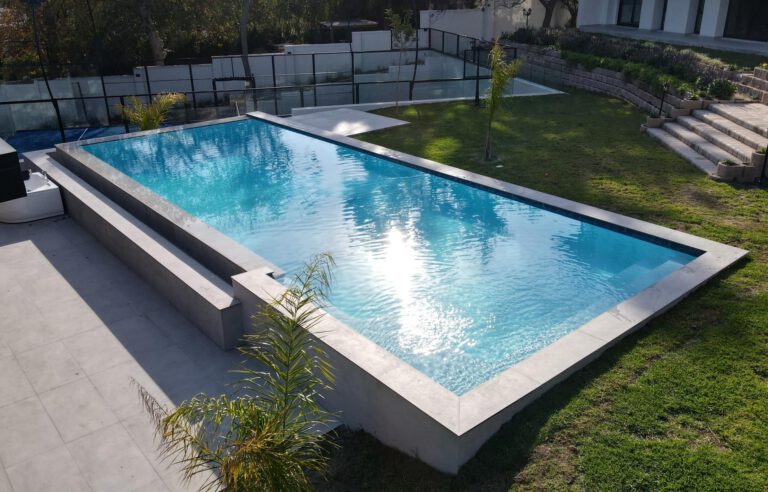
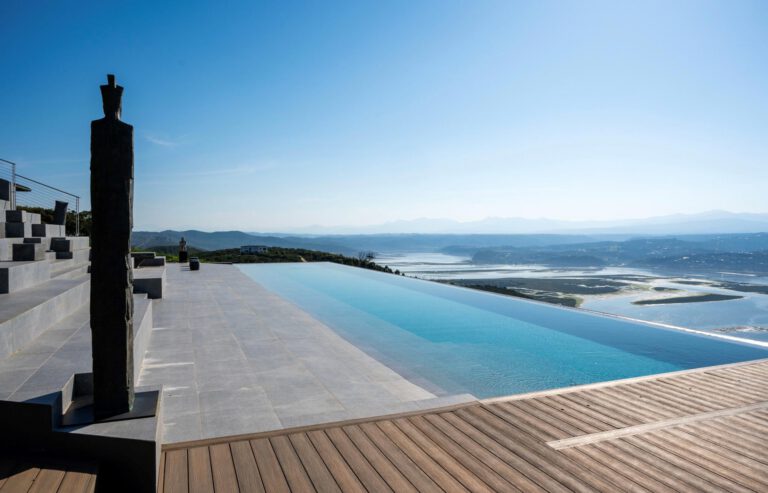
A rim-flow pool asks for everything a concrete pool asks for, plus three things of its own: a second pump circuit to power and pay for, a balance tank whose level has to be managed, and a weir face that shows every mark. Budget above the R1,200–R2,000 a month a family-sized South African pool costs to run as of August 2026.
Power — the one that defines this type
When the pump stops, a rim-flow pool stops being a rim-flow pool. The edge goes dry, the water in transit drains into the basin and the balance tank, and the tank sits full until the pump runs again. That much is cosmetic. What is not cosmetic is what happens if the system was not built for it: without a check valve on the line from the basin, water can siphon backwards out of the pool, and a basin and tank sized only for normal running will overflow and discharge whatever they cannot hold — water, and the chemicals in it. There is a documented case of exactly that, twice in under two months, on a pool with no backflow prevention.
So ask two questions: is there a check valve preventing back-siphoning when the edge pump is off, and can the basin and tank take a full drain-down? Then run the pumps on a timer with battery backup, because an outage silently resets a schedule and a rim-flow pool left off is one with a dry edge and a full tank. Eskom's April 2026 outlook forecast no load-shedding through the April-to-August winter, but municipal outages have not gone away.
At the 2026 working rate of R4.00/kWh, a 1.1 kW filtration pump running six hours a day is around R790 a month, and a second 0.75 kW variable-speed pump on the edge circuit adds roughly R540 a month — our own arithmetic (kW × hours × 30 × R4.00), because no South African source publishes a running cost for an edge pump. Running the edge a few hours rather than all day is the obvious lever.
Water — evaporation, and the Cape Town problem
A spilling edge loses more water than a still surface: moving water presents more surface to the air, and wind carries part of a thin sheet clear of the basin. The one international design calculator we found allows roughly 50% more evaporation reserve for a vanishing edge than for a deck-level slot — the honest shape of the difference, since nobody publishes litres per day for a South African rim-flow pool. A South African supplier put general pool evaporation at 35–45 mm a week in summer, and a cover at 90–95% effective against it.
Then the collision nobody in the industry appears to have addressed. Cape Town's permanent water regulations — permanent, not tied to a restriction level — require a pool to be covered when not in use, and state that automatic top-up systems using a float valve fed from a municipal drinking water source are not allowed. A rim-flow pool is designed around a balance tank that needs topping up, and international practice for this type assumes automatic top-up as standard. We could find nothing from the City, from any South African builder or from any industry body addressing a balance-tank pool under these rules. One thing is worth noticing, and it is not a workaround: the regulation names a float valve fed from municipal drinking water, where international balance-tank design uses electronic level control with a solenoid valve. If you are building a rim-flow pool in Cape Town, put the question to the City in writing before you design around automatic top-up.
Wind, coast and slope
Wind is a design input here, not a nuisance. International guidance is to size the catch basin for the height of the drop and the wind the site actually gets — the rule of thumb is a basin about as wide as the weir wall is tall — and to design for the prevailing direction. Get it wrong and the sheet blows past the basin and down the slope. Cape Town's mean wind runs from about 3 m/s in the calm months to about 6 m/s in January, so an exposed Cape view site is not a still-air site. At the coast, specify 316 marine-grade stainless for rails and fixings. On a slope, international pool engineering holds that a pool near the top of a fall must be designed so its walls carry the water without relying on the soil behind them — no published South African standard surfaced in our research, so treat it as a question for your engineer rather than an absence of a requirement.